Not Every Massachusetts Town Got More Expensive in 2026
If you've been following the housing market this year, you've probably heard plenty of headlines ...
READ

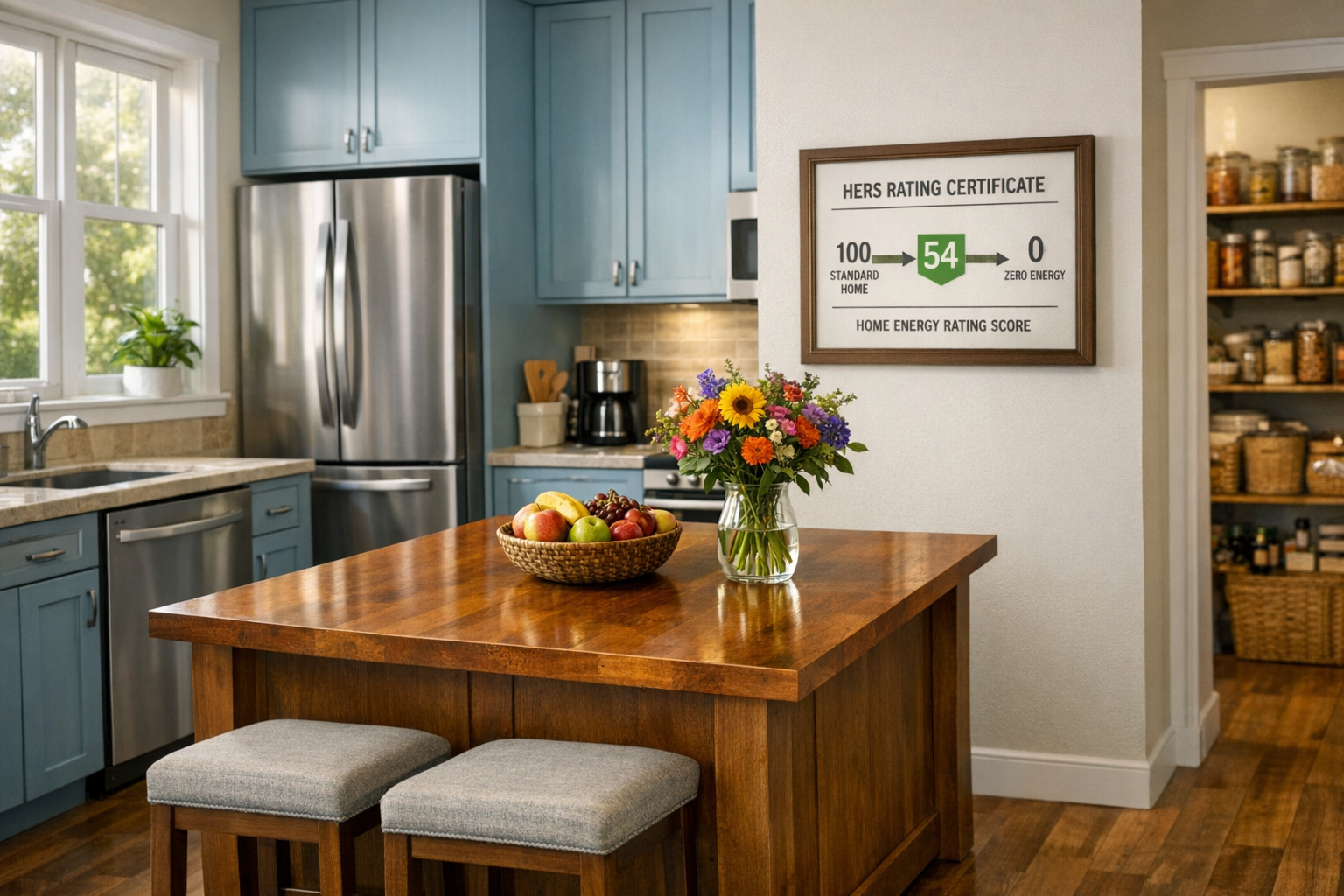
If you have toured a home with me, you already know I will absolutely stop mid showing to point out good insulation or a proper ventilation system. I promise I am still impressed by the kitchen, but today we are talking about something that actually affects how that kitchen feels to live in every single day: the HERS rating.
HERS stands for Home Energy Rating System. It is basically a miles per gallon sticker for your house. The lower the score, the more energy efficient the home. A typical older New England home in places like West Newbury, Boxford & Amesbury often scores around 100 or higher. A well built newer home might be in the 40 to 55 range. A net zero home hits zero and yes, that is as cool as it sounds - a home that actually produces as much or more energy than it consumes.
The maximum HERS rating for new construction in MA is 42, 45 or 48, depending on whether the dwelling unit is all-electric or includes embodied carbon credits. Depending on the energy source, Accessory Dwelling Units (ADUs) have a maximum HERS index of 52, 55, or 58. Almost all MA towns have selected to abide by the Stretch code (one step above the Base) with over a dozen in Greater Boston going for the Specialized Code, you can see which towns require which code here.
 If you want a really deep dive, here's a good resource.
You hire a certified HERS rater. In Massachusetts, this usually happens through an energy audit or as part of new construction and major renovations. The rater looks at insulation levels, air leakage, windows, heating and cooling systems, hot water, and ventilation. They may do a blower door test to measure air leakage and review your mechanical systems. For an existing home, the cost is often between $300 and $600, and in many cases it is bundled with or subsidized through Mass Save energy assessments.
First, it gives you a clear roadmap, instead of guessing where your house is wasting energy, the HERS report shows you exactly what is helping and what is hurting. Second, it can support refinancing, resale value, and even eligibility for certain rebates and incentive programs. Third, it helps future proof your home. As Massachusetts continues moving toward electrification and lower carbon housing, homes with better HERS scores will become the norm and will appreciate in value better.
Small projects can make a real difference. Air sealing and insulation upgrades are often the biggest bang for the buck. Sealing attic leaks and adding insulation can cost anywhere from DIY projects for a few hundred dollars to $5,000 after rebates, and homeowners commonly see energy savings of 10 to 20 percent. In real dollars, that can mean $300 to $800 per year depending on your heating costs. Upgrading to a high efficiency heat pumps for heating, cooling and hot water heater can also do a great deal to improve your HERS rating and energy savings - all these systems have real returns for your investment, unlike fossil fuel burning assets. They're also better for your home indoor air quality and your overall environmental footprint - most especially when paired with solar.
Bigger projects move the needle even more. Replacing an old oil or gas system with cold climate heat pumps can cost $15,000 to $25,000 before rebates, but Mass Save incentives can significantly reduce that number. Many homeowners see annual savings of $1,000 to $2,500, especially when paired with insulation upgrades. Over a 10 year period, that is real money, not just good intentions. Add solar to a well sealed, efficient home and the savings can climb even higher to the point where heating and cooling year-round is completely free. Even these large scale investments can have paybacks as quick as 5-7 years because of how expensive electricity is here in Massachusetts.
Beyond the utility bills, there is also value that is harder to quantify but very real. Homes with better HERS scores are quieter, more comfortable, and have better indoor air quality. Proper ventilation means fresh, filtered air instead of cold drafts sneaking in from basements and attics. For families dealing with allergies or asthma, that matters every day, not just on the electric bill.
From a market perspective, I am seeing buyers care more about efficiency too. They may not always ask for the HERS score by name yet, but they notice the comfort, the low operating costs, and the fact that the home feels solid and well thought out. As energy costs rise and efficiency becomes more mainstream, homes that have already invested in this work are going to stand out.
A HERS rating turns sustainability from a buzzword into a plan. It shows you where you are, where you can go, and what it will actually cost or save you along the way. In communities like West Newbury, Newburyport, Amesbury, and Boxford, where people care deeply about their homes and their impact on the local environment, it is one of the smartest tools you can use. And yes, I will still admire the kitchen,. but if a house has a great HERS score, I will be really stoked!
Sign up for our newsletter, stay updated on the local real estate market and learn something new about home ownership, MA real estate regulations and healthier, more efficient homes.

If you've been following the housing market this year, you've probably heard plenty of headlines ...
READ
Walk the streets of Newburyport on a summer afternoon and you will notice something subtle but ...
READ
Summer vacations are supposed to be about beaches, mountains, family visits, and getting away from ...
READ